The 1975 Cricket World Cup
The 1975 Cricket World Cup officially called the Prudential Cup was the first edition of the International Cricket Council's (ICC) cricket world cup. It was started from 7 June to 21 June 1975 in England. The tournament was sponsored by Prudential Assurance Company and had 8 participating countries. These were the 6 Test playing teams of that time namely Australia, England, India, New Zealand, Pakistan & West Indies and Sri Lanka & East Africa. The preliminary matches were played in 2 groups of 4 each. The top two teams from each group then played the knock-out rounds of semi-finals and final.

The matches were played as 60 overs per team in traditional white clothing and with red balls. They were all played during the day and, hence, started early. England scored 334 (4 wickets, 60 overs) with Dennis Amiss (137 from 147 balls, 18 fours) scoring the first ever World Cup century, nobly supported by Keith Fletcher (68 from 107 balls, 4 fours, 1 six). The response of Gavaskar (36 from 174 balls, 1 four) was to bat through the 60 overs for 36 not out.
In the final, the West Indies beat Australia by 17 runs, after an accomplished innings from captain Clive Lloyd (102 from 85 balls, 12 fours, 2 sixes). The Australian innings was marked by top-order batsmen being run out when going for runs after misfields. A total of five of their team were run out, three by Vivian Richards. There was no 'Man of the Series' awarded in 1975.
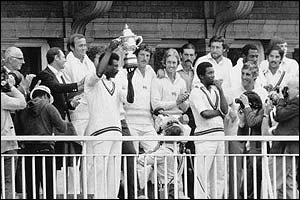
The Prudential Cup was lifted by Clive Lloyd, captain of West Indies, who had started the tournament as the favourites.
The 1979 Cricket World Cup
The 1979 Cricket World Cup (aka Prudential World Cup, 1979) was the second edition of the tournament and was won by the West Indies. It was start from June 9 to June 23, 1979 in England. The format unchanged from 1975. Eight countries participated in the event. The preliminary matches were played in 2 groups of 4 each. The top two teams in each group played the semifinals, whose winners played the final.
The matches played consisted of 60 overs per team and were played in traditional white clothing and with red balls. They were all played during the day and hence started early.
England won the toss and chose to field first. The West Indies got off to a bad start, falling to 99/4 with the loss of Greenidge, Haynes, Kallicharan, and captain Clive Lloyd. But, Vivian Richards 138 from 157 balls, 11 fours, 3 sixes and Collis King 86 from 66 balls, 10 fours, 3 sixes consolidated the innings. The West Indies were already at 5/238 when the 139 run partnership ended with the loss of Collis King. Vivian Richards and the tail then took the West Indies to a very imposing total of 286 (9 wickets, 60 overs).
The Prudential Cup was lifted by Clive Lloyd, captain of the West Indies who started as the favorites to win the cup. There was no 'Man of the Series' awarded in 1979.
The 1983 Cricket World Cup
The 1983 Cricket World Cup also known as Prudential Cup was the third edition of the tournament. It was held from 9 June to 25 June 1983 in England and was won by India. Eight countries participated in the event. The preliminary matches were played in two groups of four teams each, and each country played the others in its group twice. The top two teams in each group qualified for the semi-finals.
The matches consisted of 60 overs per team and were played in traditional white clothing and with red balls. They were all played during the day.
The 1983 World Cup was full of dramatic cricket right from the start. Teams like India and Zimbabwe who were not playing well at those times scored upset victories over the West Indies and Australia respectively. England, Pakistan, India and tournament favorites West Indies qualified for the semifinals.
In the final, India lost the toss and were asked to bat first against a West Indies team Only Kris Srikkanth 38 from 57 balls and Mohinder Amarnath 26 from 80 balls put up against Roberts, Marshall, Joel Garner and Michael Holding ripped through the Indian batsmen, well supported by Gomes. Surprising India all out 183 (all out, 54.4 overs). However, the Indian bowling exploited the weather and pitch conditions perfectly to bowl out the best batting lineup of the era for 140 from 52 overs in return, winning by 43 runs and completing one of the most stunning upsets in cricket history, defeating the previously invincible West Indies.
Amarnath and Madan Lal (3-31) each took three wickets, and one memorable moment was the sight of Kapil Dev running a great distance about 18-20 yards to take a catch to dismiss Richards, the West Indies top scorer with 33 from 28 balls. Amarnath was the most economical bowler, conceding just 12 runs from his seven overs while taking 3 wickets, and was once again awarded the Man of the Match award for his all-round performance.There was no 'Man of the Series' awarded in 1983.
The 1987 Cricket World Cup
The 1987 Cricket World Cup it is Reliance World Cup was the fourth edition of the tournament. It was held from October 8 to November 8, 1987 in both India and Pakistan. The format was unchanged but reduces the number of overs a team played from 60 to 50. 8 countries participated in the event. The preliminary matches were played in 2 groups of 4 each in which each country played its groupmates twice. The top two teams in each group qualified for the semifinals, whose winners played the final. The matches were played with traditional white clothing and with red balls.
They were all played during the day. There was no 'Man of the Series' awarded in 1987.
The 1987 World Cup was lifted by Allan Border, captain of Australia who won against arch-rivals England by 7 runs in the most closely fought World Cup final to date in the Eden Gardens stadium in Calcutta. The other semifinalists, India and Pakistan failed to bring about an eagerly awaited India-Pakistan final. The West Indies failed to live up to expectations by not even qualifying for the semifinals (in part because of Courtney Walsh's refusal to mankad Saleem Jaffar). David Boon was man of the match.
Australia 253/5 (50 overs) v England
246/8 (50 overs) Australia won by 7 runs
Eden Gardens, Calcutta, India
Umpires: Ram Gupta and Mahboob Shah
Player of the match: David Boon David Boon 75 (125)
Eddie Hemmings 2/48 (10 overs) Bill Athey 58 (103)
Steve Waugh 2/37 (9 overs)
The 1992 Cricket World Cup
The 1992 Cricket World Cup sponsored by Benson & Hedges World Cup was the fifth edition of the tournament and was held from 22 February to 25 March 1992 in Australia and New Zealand. Sponsored by Benson and Hedges, it was won by Pakistan, who defeated England in the final.
The final will be remembered by all Pakistanis as they saw two of their greatest cricketers, Imran Khan and Javed Miandad, perform superbly as they set a target of 250, which proved too much for England to chase.
Pakistan 249/6 (50 overs) v England
227 all out (49.2 overs) Pakistan won by 22 runs
Melbourne Cricket Ground, Melbourne, Australia
Umpires: Brian Aldridge and Steve Bucknor
Player of the match: Wasim Akram Imran Khan 72 (110 balls)
Derek Pringle 3/22 (10 overs) Neil Fairbrother 62 (70 balls)
Mushtaq Ahmed 3/41 (10 overs)
The 1996 Cricket World Cup
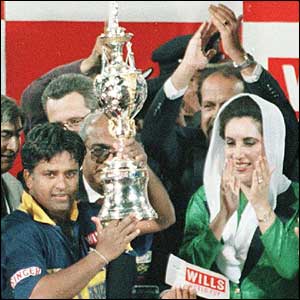
The 1996 Cricket World Cup, also called the Wills World Cup after its official sponsors, was the sixth edition of the tournament organized by the International Cricket Council (ICC). It was the second World Cup to be hosted by Pakistan and India, and for the first time by Sri Lanka. The tournament was won by Sri Lanka, who defeated Australia in the final at the Gaddafi Stadium in Lahore, Punjab, Pakistan.
Sri Lanka won the toss and chose to field. Mark Taylor 74 from 83 balls, 8 fours, 1 six and Ricky Ponting 45 from 73 balls, 2 fours shared a second-wicket partnership of 101 runs. When Ponting and Taylor were dismissed, however, Australia fell from 1/137 to 5/170 as the famed 4-pronged spin attack of Sri Lanka took its toll. Despite the slump, Australia struggled on to 241 (7 wickets, 50 overs)
Australia
241/7 (50 overs) v Sri Lanka
245/3 (46.2 overs) Sri Lanka won by 7 wickets
Gaddafi Stadium, Lahore, Pakistan
Umpires: Steve Bucknor and David Shepherd
Player of the match: Aravinda de Silva Mark Taylor 74 (83)
Aravinda de Silva 3/42 (9 overs) Aravinda de Silva 107 (124)
Damien Fleming 1/43 (6 overs)
The 1999 Cricket World Cup
The 1999 Cricket World Cup, the seventh edition of the tournament, was hosted primarily by England, but Ireland, Wales, Scotland and the Netherlands also hosted some games. The World Cup was won by Australia, who beat Pakistan by 8 wickets at Lord's Cricket Ground in London. New Zealand and South Africa were the other semifinalists.
The format of the world cup was as follows: The 12 contestants were divided into 2 groups, in each of which teams played each other in the league stage. The top three from each group advanced to the Super Sixes, a new concept brought about in this World Cup, where each qualifier from group A played with each qualifier from group B. The teams also carried forward their points from games against each qualifer from their group. The top four in the Super Sixes contested the semifinals.
Pakistan132 (39 overs) v Australia
133/2 (20.1 overs) Australia won by 8 wickets
Lord's, London, England
Umpires: Steve Bucknor (WI) and David Shepherd (ENG)
Player of the match: Shane Warne (AUS) Ijaz Ahmed 22 (46)
Shane Warne 33/4 (9 overs) Adam Gilchrist 54 (36)
Saqlain Mushtaq 21/1 (4.1 overs)
The 2003 ICC Cricket World Cup
The 2003 ICC Cricket World Cup was the eighth Cricket World Cup and was played in South Africa, Zimbabwe, Kenya from 9 February to 24 March. 2003 was the first time that the Cricket World Cup conducted in Africa. The tournament featured 14 teams and 54 matches, the most in the tournament history up to that time. The tournament followed the format introduced in the 1999 Cricket World Cup with the teams divided into 2 groups, and the top three in each group qualifying for the Super Sixes stage.
The tournament saw upsets in the first round with South Africa, Pakistan, West Indies and England failing to make it to Super Sixes stage while Zimbabwe and Kenya made it to Super Sixes stage and Kenya, a non-Test playing nation, made the semi-finals of the tournament.
Australian star player
Shane Warne was sent home from the cup in embarrassing situation, only the day before their opening game, after a positive doping test in a lead-up competition in Australia revealed that he had taken a banned diuretic. The leg spinner claimed that he had taken a 'fluid pill' on the advice of his mother.
The tournament was won by Ricky Ponting's Australia who defeated India Sourav Ganguly's India in the final.
Australia 359/2 (50 overs) v India
234 (39.1 overs) Australia won by 125 runs
Wanderers Stadium, Johannesburg, South Africa
The 2007 ICC Cricket World Cup
The 2007 ICC Cricket World Cup was the ninth edition of the tournament and took place in the West Indies from 13 March to 28 April 2007, using the sport's One Day International format. There were a total of 51 matches played.
The 16 competing teams were initially divided into four groups, with the two best-performing teams from each group moving on to a "Super 8" format. From this, Australia, New Zealand, Sri Lanka and South Africa won through to the semi-finals, with Australia defeating Sri Lanka in the final to win their third consecutive World Cup. Australia's unbeaten record in the tournament increased their total to 29 consecutive World Cup matches without loss, a streak dating back to 23 May 1999, during the group stage of the 1999 World Cup.
Pakistan coach
Bob Woolmer was found dead on 18 March 2007, one day after his team's defeat to Ireland put them out of the running for the World Cup. Jamaican police performed an autopsy which was deemed inconclusive.
Australia 281/4 (38 overs) v Sri Lanka 215/8 (36 overs)
Australia won by 53 runs (DL)
Kensington Oval, Bridgetown, Barbados.
The tournament the ICC distributed surplus tournament revenues of USD 239 million to its members.
The 2011 ICC Cricket World Cup
The 2011 ICC Cricket World Cup is the tenth Cricket World Cup and is being hosted by three South Asian Test cricket playing countries: India, Sri Lanka and Bangladesh. It will be Bangladesh's first time co-hosting a Cricket World Cup. The World Cup will take place between February and early April 2011, with the first match played on 19 February 2011 with co-hosts India and Bangladesh facing off at the Sher-e-Bangla National Stadium in Mirpur, Dhaka. The opening ceremony was held on 17 February 2011 at Bangabandhu National Stadium, Dhaka, two days before the start of the tournament, with the final on 2 April 2011 at Wankhede Stadium, Mumbai.
The World Cup was also supposed to be co-hosted by Pakistan, but in the wake of the 2009 attack on the Sri Lanka national cricket team in Lahore, the International Cricket Council (ICC) decided to take Pakistan of its hosting rights.
The headquarters of the organising committee were originally situated in Lahore, but have now been shifted to Mumbai. Pakistan was supposed to hold 14 matches, including one semi-final. Eight of Pakistan's matches were atransfered to India, four to Sri Lanka and two to Bangladesh.
TME TABLE - 2011 World Cup